

[Sep-2026] Databricks Databricks-Certified-Data-Engineer-Associate Official Cert Guide PDF
Exam Databricks-Certified-Data-Engineer-Associate: Databricks Certified Data Engineer Associate Exam - Pass4sures
The GAQM Databricks-Certified-Data-Engineer-Associate (Databricks Certified Data Engineer Associate) Exam is a certification program designed to assess an individual's expertise in data engineering using Databricks. Databricks-Certified-Data-Engineer-Associate exam is designed to test the practical knowledge and skills required to work with big data using Databricks, a cloud-based data analytics platform.
NEW QUESTION # 12
Which of the following is stored in the Databricks customer's cloud account?
- A. Notebooks
- B. Databricks web application
- C. Repos
- D. Cluster management metadata
- E. Data
Answer: E
Explanation:
The only option that is stored in the Databricks customer's cloud account is data. Data is stored in the customer's cloud storage service, such as AWS S3 or Azure Data Lake Storage. The customer has full control and ownership of their data and can access it directly from their cloud account.
Option A is not correct, as the Databricks web application is hosted and managed by Databricks on their own cloud infrastructure. The customer does not need to install or maintain the web application, but only needs to access it through a web browser.
Option B is not correct, as the cluster management metadata is stored and managed by Databricks on their own cloud infrastructure. The cluster management metadata includes information such as cluster configuration, status, logs, and metrics. The customer can view and manage their clusters through the Databricks web application, but does not have direct access to the cluster management metadata.
Option C is not correct, as the repos are stored and managed by Databricks on their own cloud infrastructure.
Repos are version-controlled repositories that store code and data files for Databricks projects. The customer can create and manage their repos through the Databricks web application, but does not have direct access to the repos.
Option E is not correct, as the notebooks are stored and managed by Databricks on their own cloud infrastructure. Notebooks are interactive documents that contain code, text, and visualizations for Databricks workflows. The customer can create and manage their notebooks through the Databricks web application, but does not have direct access to the notebooks.
References:
* Databricks Architecture
* Databricks Data Sources
* Databricks Repos
* [Databricks Notebooks]
* [Databricks Data Engineer Professional Exam Guide]
NEW QUESTION # 13
A data engineer has realized that they made a mistake when making a daily update to a table. They need to use Delta time travel to restore the table to a version that is 3 days old. However, when the data engineer attempts to time travel to the older version, they are unable to restore the data because the data files have been deleted.
Which of the following explains why the data files are no longer present?
- A. The OPTIMIZE command was nun on the table
- B. The DELETE HISTORY command was run on the table
- C. The TIME TRAVEL command was run on the table
- D. The VACUUM command was run on the table
- E. The HISTORY command was run on the table
Answer: D
Explanation:
The VACUUM command is used to remove files that are no longer referenced by a Delta table and are older than the retention threshold1. The default retention period is 7 days2, but it can be changed by setting the delta.logRetentionDuration and delta.deletedFileRetentionDuration configurations3. If the VACUUM command was run on the table with a retention period shorter than 3 days, then the data files that were needed to restore the table to a 3-day-old version would have been deleted. The other commands do not delete data files from the table. The TIME TRAVEL command is used to query a historical version of the table4. The DELETE HISTORY command is not a valid command in Delta Lake. The OPTIMIZE command is used to improve the performance of the table by compacting small files into larger ones5. The HISTORY command is used to retrieve information about the operations performed on the table. Reference: 1: VACUUM | Databricks on AWS 2: Work with Delta Lake table history | Databricks on AWS 3: [Delta Lake configuration | Databricks on AWS] 4: Work with Delta Lake table history - Azure Databricks 5: [OPTIMIZE | Databricks on AWS] : [HISTORY | Databricks on AWS]
NEW QUESTION # 14
A data engineer has a Job with multiple tasks that runs nightly. Each of the tasks runs slowly because the clusters take a long time to start.
Which of the following actions can the data engineer perform to improve the start up time for the clusters used for the Job?
- A. They can configure the clusters to autoscale for larger data sizes
- B. They can use clusters that are from a cluster pool
- C. They can configure the clusters to be single-node
- D. They can use endpoints available in Databricks SQL
- E. They can use jobs clusters instead of all-purpose clusters
Answer: E
NEW QUESTION # 15
Which compute option should be chosen in a scenario where small-scale ad-hoc Python scripts need to be run at high frequency and should wind down quickly after these queries have finished running?
- A. Serverless Compute
- B. Job Cluster
- C. All-purpose Cluster
- D. SQL Warehouse
Answer: A
Explanation:
Serverless Compute is ideal for small-scale, frequent, ad-hoc Python scripts because it provisions automatically, scales quickly, and terminates when queries finish, minimizing operational overhead and costs.
NEW QUESTION # 16
A data engineering team needs to integrate two data sources into Databricks:
Clickstream events: 5,000 events per second from an Apache Kafka topic
Customer master data: Only changed records every four hours from a Snowflake database The solution must process clickstream data with latency under 30 seconds and prevent reprocessing customer master data that has not changed.
Which ingestion approach meets these requirements?
- A. Use a non-incremental Snowflake connector, fetch all data every four hours, and apply MERGE operations.
- B. Use spark.readStream() with Kafka and query Snowflake hourly using a time-based filter.
- C. Use Structured Streaming for Kafka and a Lakeflow Connect connector with a full refresh for Snowflake.
- D. Use Structured Streaming for Kafka and a Lakeflow Connect managed connector with incremental processing for Snowflake.
Answer: D
NEW QUESTION # 17
A data engineer has developed a data pipeline to ingest data from a JSON source using Auto Loader, but the engineer has not provided any type inference or schema hints in their pipeline. Upon reviewing the data, the data engineer has noticed that all of the columns in the target table are of the string type despite some of the fields only including float or boolean values.
Which of the following describes why Auto Loader inferred all of the columns to be of the string type?
- A. There was a type mismatch between the specific schema and the inferred schema
- B. JSON data is a text-based format
- C. All of the fields had at least one null value
- D. Auto Loader only works with string data
- E. Auto Loader cannot infer the schema of ingested data
Answer: B
Explanation:
JSON data is a text-based format that represents data as a collection of name-value pairs. By default, when Auto Loader infers the schema of JSON data, it treats all columns as strings. This is because JSON data can have varying data types for the same column across different files or records, and Auto Loader does not attempt to reconcile these differences. For example, a column named "age" may have integer values in some files, but string values in others. To avoid data loss or errors, Auto Loader infers the column as a string type. However, Auto Loader also provides an option to infer more precise column types based on the sample data. This option is called cloudFiles.inferColumnTypes and it can be set to true or false. When set to true, Auto Loader tries to infer the exact data types of the columns, such as integers, floats, booleans, or nested structures. When set to false, Auto Loader infers all columns as strings. The default value of this option is false. Reference: Configure schema inference and evolution in Auto Loader, Schema inference with auto loader (non-DLT and DLT), Using and Abusing Auto Loader's Inferred Schema, Explicit path to data or a defined schema required for Auto loader.
NEW QUESTION # 18
A data engineer and data analyst are working together on a data pipeline. The data engineer is working on the raw, bronze, and silver layers of the pipeline using Python, and the data analyst is working on the gold layer of the pipeline using SQL. The raw source of the pipeline is a streaming input. They now want to migrate their pipeline to use Delta Live Tables.
Which of the following changes will need to be made to the pipeline when migrating to Delta Live Tables?
- A. The pipeline will need to stop using the medallion-based multi-hop architecture
- B. None of these changes will need to be made
- C. The pipeline will need to be written entirely in SQL
- D. The pipeline will need to use a batch source in place of a streaming source
- E. The pipeline will need to be written entirely in Python
Answer: B
Explanation:
Delta Live Tables is a declarative framework for building reliable, maintainable, and testable data processing pipelines. You define the transformations to perform on your data and Delta Live Tables manages task orchestration, cluster management, monitoring, data quality, and error handling. Delta Live Tables supports both SQL and Python as the languages for defining your datasets and expectations. Delta Live Tables also supports both streaming and batch sources, and can handle both append-only and upsert data patterns. Delta Live Tables follows the medallion lakehouse architecture, which consists of three layers of data: bronze, silver, and gold. Therefore, migrating to Delta Live Tables does not require any of the changes listed in the options B, C, D, or E. The data engineer and data analyst can use the same languages, sources, and architecture as before, and simply declare their datasets and expectations using Delta Live Tables syntax. References:
* What is Delta Live Tables?
* Transform data with Delta Live Tables
* What is the medallion lakehouse architecture?
NEW QUESTION # 19
A data engineer needs to enforce row-level security on main.secure.events(region STRING, event_id STRING). Members of the account group all_regions must see all rows. All other users must see only rows where region = 'EU'.
Which SQL sequence satisfies the requirement?
- A. CREATE FUNCTION main.secure.region_filter(region STRING)
RETURN IF(is_account_group_member('all_regions'), true, region = 'EU'); ALTER TABLE main.secure.events ALTER COLUMN region SET MASK main.secure.region_filter; - B. CREATE FUNCTION main.secure.region_filter(region STRING)
RETURN IF(is_account_group_member('all_regions'), true, region = 'EU'); ALTER TABLE main.secure.events SET ROW FILTER main.secure.region_filter USING COLUMNS (region); - C. CREATE FUNCTION main.secure.region_filter(region STRING)
RETURN IF(is_account_group_member('all_regions'), true, region = 'EU'); ALTER TABLE main.secure.events SET ROW FILTER main.secure.region_filter ON (region); - D. CREATE FUNCTION main.secure.region_filter(region STRING)
RETURN IF(is_account_group_member('all_regions'), true, region = 'EU'); ALTER VIEW main.secure.events SET ROW FILTER main.secure.region_filter ON (region);
Answer: C
Explanation:
A row-filter function must return a Boolean value indicating whether each row is visible to the current user. The function in option A returns true for members of the account-level all_regions group, allowing them to see every row. For other users, it returns the result of region = 'EU', limiting visibility to European records. is_account_group_member checks direct or indirect membership in an account-level group. The ALTER TABLE ... SET ROW FILTER ... ON (region) statement then associates the function with the table and passes the region column to it for every query. A column mask transforms displayed column values rather than removing rows. The object is a table, not a view, and USING COLUMNS is not the correct row-filter attachment syntax. Therefore, option A is correct.
NEW QUESTION # 20
The Delta transaction log for the 'students' tables is shown using the 'DESCRIBE HISTORY students' command. A Data Engineer needs to query the table as it existed before the UPDATE operation listed in the log.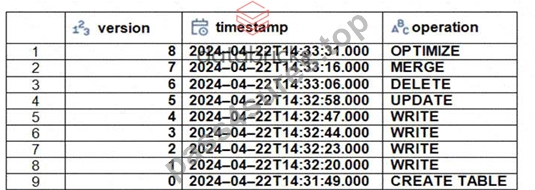
Which command should the Data Engineer use to achieve this? (Choose two.)
- A. SELECT * FROM students FROM HISTORY VERSION AS OF 3
- B. SELECT * FROM students TIMESTAMP AS OF '2024-04-22T 14:32:58.000+00:00'
- C. SELECT * FROM students VERSION AS OF 5
- D. SELECT * FROM students@v4
- E. SELECT * FROM students TIMESTAMP AS OF '2024-04-22T 14:32:47.000+00:00'
Answer: D,E
NEW QUESTION # 21
Which of the following tools is used by Auto Loader process data incrementally?
- A. Spark Structured Streaming
- B. Databricks SQL
- C. Data Explorer
- D. Checkpointing
- E. Unity Catalog
Answer: A
Explanation:
Auto Loader provides a Structured Streaming source called cloudFiles that can process new data files as they arrive in cloud storage without any additional setup. Auto Loader uses a scalable key-value store to track ingestion progress and ensure exactly-once semantics. Auto Loader can ingest various file formats and load them into Delta Lake tables. Auto Loader is recommended for incremental data ingestion with Delta Live Tables, which extends the functionality of Structured Streaming and allows you to write declarative Python or SQL code to deploy a production-quality data pipeline. References: What is Auto Loader?, What is Auto Loader? | Databricks on AWS, Solved: How does Auto Loader ingest data? - Databricks - 5629
NEW QUESTION # 22
A data engineer needs to create a table in Databricks using data from their organization's existing SQLite database. They run the following command:
CREATE TABLE jdbc_customer360
USING
OPTIONS (
url "jdbc:sqlite:/customers.db", dbtable "customer360"
)
Which line of code fills in the above blank to successfully complete the task?
- A. autoloader
- B. sqlite
- C. org.apache.spark.sql.sqlite
- D. org.apache.spark.sql.jdbc
Answer: D
Explanation:
To create a table in Databricks using data from an SQLite database, the correct syntax involves specifying the format of the data source. The format in the case of using JDBC (Java Database Connectivity) with SQLite is specified by the org.apache.spark.sql.jdbc format. This format allows Spark to interface with various relational databases through JDBC. Here is how the command should be structured:
CREATE TABLE jdbc_customer360
USING org.apache.spark.sql.jdbc
OPTIONS (
url "jdbc:sqlite:/customers.db",
dbtable "customer360"
)
The USING org.apache.spark.sql.jdbc line specifies that the JDBC data source is being used, enabling Spark to interact with the SQLite database via JDBC.
References:Databricks documentation on JDBC: Connecting to SQL Databases using JDBC
NEW QUESTION # 23
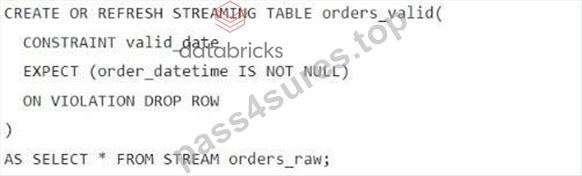
A data engineer is processing ingested streaming tables and needs to filter out NULL values in the order_datetime column from the raw streaming table orders_raw and store the results in a new table orders_valid using DLT. Which code snippet should the data engineer use?
- A.
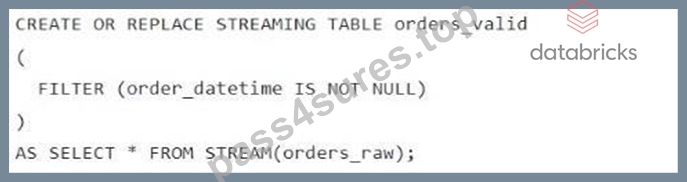
- B.
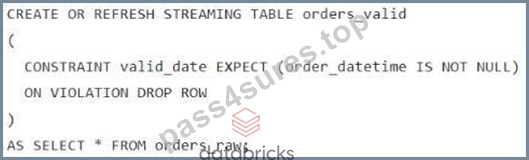
- C.
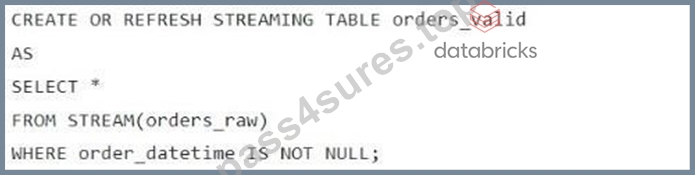
- D.
Answer: D
Explanation:
The correct approach is to use a DLT expectation with constraint CONSTRAINT valid_date EXPECT (order_datetime IS NOT NULL) ON VIOLATION DROP ROW This ensures rows with NULL order_datetime are filtered out automatically during streaming ingestion while keeping the pipeline valid.
NEW QUESTION # 24
What is the functionality of AutoLoader in Databricks?
- A. Auto Loader automatically ingests and processes new files from cloud storage, handling both batch and streaming data with support for schema evolution.
- B. Auto Loader automatically ingests and processes new files from cloud storage, handling batch data with support for schema evolution.
- C. Auto Loader automatically ingests and processes new files from cloud storage, handling batch and streaming data with no support for schema evolution.
- D. Auto Loader automatically ingests and processes new files from cloud storage, handling only streaming data with no support for schema evolution.
Answer: A
NEW QUESTION # 25
A data engineer has configured a Structured Streaming job to read from a table, manipulate the data, and then perform a streaming write into a new table.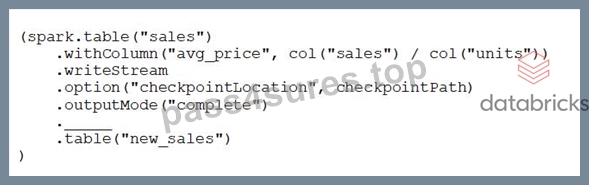
The code block used by the data engineer is below:
Which line of code should the data engineer use to fill in the blank if the data engineer only wants the query to execute a micro-batch to process data every 5 seconds?
- A. trigger("5 seconds")
- B. trigger(once="5 seconds")
- C. trigger(processingTime="5 seconds")
- D. trigger(continuous="5 seconds")
Answer: C
NEW QUESTION # 26
A team creates YAML manifests that declare jobs, resources, and dependencies, then deploys them to Databricks using the Databricks CLI. The deployment succeeds.
Which feature are they using?
- A. Databricks Asset Bundles
- B. Terraform
- C. DataOps
- D. GitHub
Answer: A
Explanation:
Databricks Asset Bundles are a Databricks CLI feature that lets teams define Databricks projects "as code" using YAML configuration files. In a bundle, metadata is expressed in YAML (for example, a required databricks.yml at the root), and the configuration can declare resources (such as Databricks Jobs/workflows and other supported assets), artifacts, and deployment targets. After defining these YAML manifests, teams use the Databricks CLI to validate, deploy, and run the bundle into a Databricks workspace, which matches the scenario described (YAML + CLI deployment). This approach standardizes how workflows and related resources are packaged and promoted across environments (dev/test/prod) while keeping definitions version-controlled and reproducible. GitHub is only a hosting/version-control platform (not the YAML deployment feature itself), Terraform is a separate IaC tool, and "DataOps" is a methodology rather than a specific Databricks feature. (Databricks Documentation)
NEW QUESTION # 27
A data analysis team has noticed that their Databricks SQL queries are running too slowly when connected to their always-on SQL endpoint. They claim that this issue is present when many members of the team are running small queries simultaneously. They ask the data engineering team for help. The data engineering team notices that each of the team's queries uses the same SQL endpoint.
Which of the following approaches can the data engineering team use to improve the latency of the team's queries?
- A. They can turn on the Serverless feature for the SQL endpoint.
- B. They can turn on the Auto Stop feature for the SQL endpoint.
- C. They can increase the maximum bound of the SQL endpoint's scaling range.
- D. They can increase the cluster size of the SQL endpoint.
- E. They can turn on the Serverless feature for the SQL endpoint and change the Spot Instance Policy to
"Reliability Optimized."
Answer: C
Explanation:
https://community.databricks.com/t5/data-engineering/sequential-vs-concurrency-optimization-questions-from-q
NEW QUESTION # 28
A data engineer needs to control access to data assets across multiple workspaces and enforce centralized governance policies. The organization wants fine-grained access control for tables, schemas, and catalogs. Which Databricks feature supports this requirement?
- A. MLflow
- B. Unity Catalog
- C. Delta Cache
- D. DBFS
Answer: B
NEW QUESTION # 29
A data engineer team has decided to implement a new data platform on Databricks and is currently deciding how to store each kind of data on each data layer. What is the appropriate layer and data pairing for medallion architecture?
- A. Silver Layer - Raw data from deposit account application
- B. Silver Layer - Cleansed master customer data
- C. Gold Layer - Deduplicated money transfer transaction
- D. Bronze Layer - Summary of cash deposit amount for each country and city
Answer: B
Explanation:
In the Medallion architecture, the Silver layer holds cleansed and conformed data (such as master customer data), which has been cleaned, validated, and standardized after ingestion from the Bronze layer.
NEW QUESTION # 30
A data engineer has a single-task Job that runs each morning before they begin working. After identifying an upstream data issue, they need to set up another task to run a new notebook prior to the original task.
Which of the following approaches can the data engineer use to set up the new task?
- A. They can clone the existing task in the existing Job and update it to run the new notebook.
- B. They can create a new job from scratch and add both tasks to run concurrently.
- C. They can create a new task in the existing Job and then add the original task as a dependency of the new task.
- D. They can clone the existing task to a new Job and then edit it to run the new notebook.
- E. They can create a new task in the existing Job and then add it as a dependency of the original task.
Answer: E
Explanation:
To set up the new task to run a new notebook prior to the original task in a single-task Job, the data engineer can use the following approach: In the existing Job, create a new task that corresponds to the new notebook that needs to be run. Set up the new task with the appropriate configuration, specifying the notebook to be executed and any necessary parameters or dependencies. Once the new task is created, designate it as a dependency of the original task in the Job configuration. This ensures that the new task is executed before the original task.
NEW QUESTION # 31
A data engineer has left the organization. The data team needs to transfer ownership of the data engineer's Delta tables to a new data engineer. The new data engineer is the lead engineer on the data team.
Assuming the original data engineer no longer has access, which of the following individuals must be the one to transfer ownership of the Delta tables in Data Explorer?
- A. New lead data engineer
- B. Workspace administrator
- C. Databricks account representative
- D. This transfer is not possible
- E. Original data engineer
Answer: B
Explanation:
The workspace administrator is the only individual who can transfer ownership of the Delta tables in Data Explorer, assuming the original data engineer no longer has access. The workspace administrator has the highest level of permissions in the workspace and can manage all resources, users, and groups. The other options are either not possible or not sufficient to perform the ownership transfer. The Databricks account representative is not involved in the workspace management. The transfer is possible and not dependent on the original data engineer. The new lead data engineer may not have the necessary permissions to access or modify the Delta tables, unless granted by the workspace administrator or the original data engineer before leaving. Reference: Workspace access control, Manage Unity Catalog object ownership.
NEW QUESTION # 32
A data architect has determined that a table of the following format is necessary: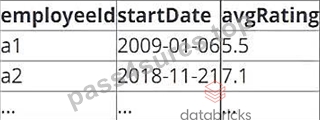
Which of the following code blocks uses SQL DDL commands to create an empty Delta table in the above format regardless of whether a table already exists with this name?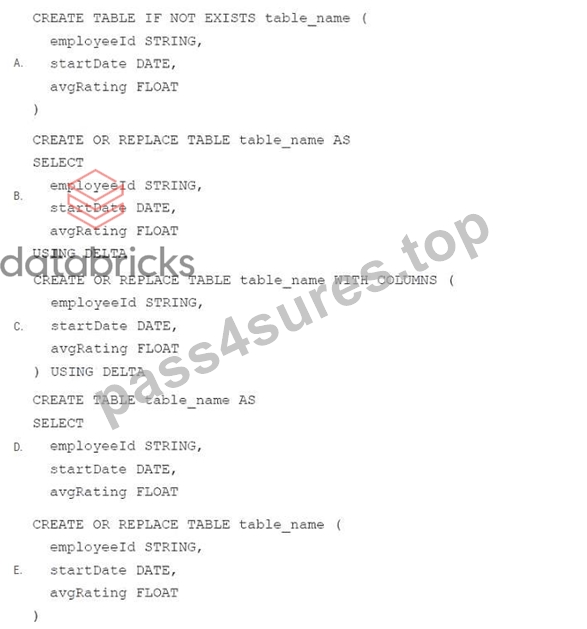
- A. Option A
- B. Option D
- C. Option B
- D. Option C
- E. Option E
Answer: E
Explanation:
Create a table using SQL | Databricks on AWS, Create a table using SQL - Azure Databricks, Delta Lake Quickstart - Azure Databricks
NEW QUESTION # 33
A data engineer needs to conduct Exploratory Data Analysis (EDA) on data residing in a database within the company's custom-defined cloud network. The data engineer is using SQL for this task.
Which type of SQL Warehouse will enable the data engineer to process large numbers of queries quickly and cost-effectively?
- A. Classic SQL Warehouse
- B. All-purpose compute cluster
- C. Pro SQL Warehouse
- D. SQL Serverless Warehouse
Answer: D
Explanation:
A SQL Serverless Warehouse is the most suitable option for running SQL-based exploratory data analysis at scale while minimizing operational and cost overhead. Serverless SQL warehouses are fully managed by Databricks, meaning Databricks automatically provisions and scales compute resources, applies Photon acceleration, and optimizes query execution without requiring the user to manage infrastructure. This makes them ideal for workloads involving large numbers of ad hoc or interactive SQL queries, which is common during EDA. Because the data resides in a custom-defined cloud network, serverless SQL warehouses can still securely access governed data when Unity Catalog and networking requirements are satisfied. All- purpose clusters (option A) are designed for collaborative development and mixed workloads, not cost- efficient high-concurrency SQL querying. Classic SQL warehouses (option D) are legacy and lack the performance and cost optimizations of newer serverless offerings. Pro SQL warehouses (option B) require user-managed sizing decisions, whereas serverless warehouses optimize both performance and cost automatically. Databricks documentation recommends SQL Serverless Warehouses for fast, scalable, and cost-effective SQL analytics.
=========
NEW QUESTION # 34
A data engineer has configured a Structured Streaming job to read from a table, manipulate the data, and then perform a streaming write into a new table.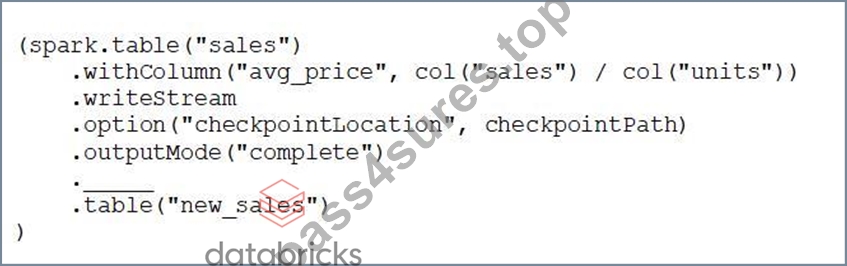
The code block used by the data engineer is below:
Which line of code should the data engineer use to fill in the blank if the data engineer only wants the query to execute a micro-batch to process data every 5 seconds?
- A. trigger("5 seconds")
- B. trigger(once="5 seconds")
- C. trigger(processingTime="5 seconds")
- D. trigger(continuous="5 seconds")
Answer: C
NEW QUESTION # 35
......
The GAQM Databricks-Certified-Data-Engineer-Associate exam is a certification exam designed for data engineers who want to prove their proficiency in designing and building data pipelines using Databricks. The Databricks Certified Data Engineer Associate certification is highly valued in the data engineering industry and is recognized globally. Databricks Certified Data Engineer Associate Exam certification covers various topics related to data engineering, big data processing and analytics, and cloud computing using Databricks. Databricks Certified Data Engineer Associate Exam certification is ideal for data engineers who work with Databricks and want to advance their careers in data engineering.
Free Databricks-Certified-Data-Engineer-Associate Exam Dumps to Improve Exam Score: https://exams4sure.pass4sures.top/Databricks-Certification/Databricks-Certified-Data-Engineer-Associate-testking-braindumps.html