

[Aug 26, 2026] Latest JNCIS-ENT JN0-650 Actual Free Exam Questions
JNCIS-ENT JN0-650 Dumps Updated Practice Test and 124 unique questions
NEW QUESTION # 73
You have a workstation and an IP phone that connect to the same physical port on your Juniper switch.
Which statement is true?
- A. The access port can be configured to accept tagged and untagged traffic.
- B. The workstation and the phone both must send tagged traffic to the switch.
- C. You must configure two logical interfaces on the switch port.
- D. The switch port must be configured as a trunk port.
Answer: A
NEW QUESTION # 74
Click the Exhibit button.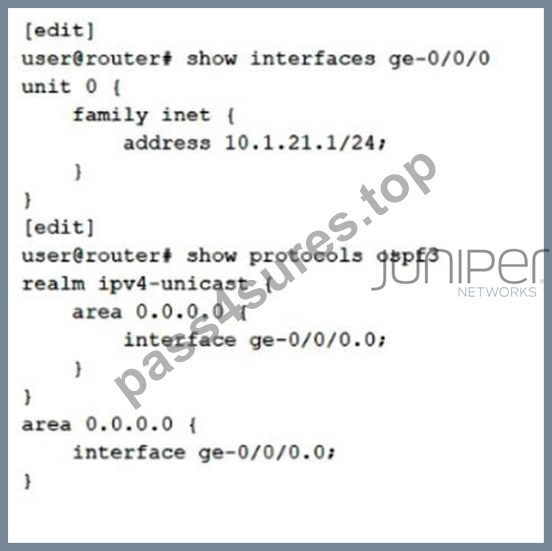
You are asked to implement IPv4 routing using OSPFv3 but the OSPFv3 adjacency is not established.
Referring to the exhibit, which configuration statement is needed to establish OSPFv3 adjacency?
- A. set protocols ospf3 realm ipv4-multicast
- B. set interface ge-0/0/0 unit 0 family inet6
- C. set protocols ospf area 0 interface ge-0/0/0
- D. set protocols ospf3 realm ipv6-unicast
Answer: B
Explanation:
OSPFv3 uses IPv6 link-local addressing to form adjacencies, even when it is carrying IPv4 unicast routes. The interface must have IPv6 enabled with family inet6 so the router can generate a link-local address and establish the OSPFv3 neighbor relationship.
NEW QUESTION # 75
When configuring Q-in-Q tunneling, which type of tunneling involves the swapping of S-VLANs with C-VLANs?
- A. L2PT
- B. all-in-one
- C. VLAN rewrites
- D. many-to-many
Answer: C
Explanation:
VLAN rewrites in Q-in-Q tunneling perform tag manipulation operations, including swapping S- VLAN tags with C-VLAN tags. This functionality is used when VLAN identifiers must be modified as frames traverse the provider network.
NEW QUESTION # 76
You have configured class mode power management on an EX4300 to provide PoE power to telephone and security camera equipment. You want to ensure that security camera power takes priority over telephone power.
Which two actions would solve this problem? (Choose two.)
- A. Set the power priority to low on ports connected to security cameras.
- B. Connect the security cameras to the lowest port numbers on the switch.
- C. Set the maximum power settings on ports connected to security cameras.
- D. Set the power priority to high on ports connected to security cameras.
Answer: B,D
NEW QUESTION # 77
When configuring multicast routing policies, what is a common action?
- A. To define which multicast sources to accept or deny
- B. To convert multicast traffic to unicast for easier routing
- C. To increase the priority of multicast over unicast traffic
- D. To set the administrative distance of multicast routes
Answer: A
NEW QUESTION # 78
Which two statements are true regarding BGP peering sessions? (Choose two.)
- A. BGP keepalives consist of a BGP header with no payload.
- B. BGP updates are registered as keepalives.
- C. BGP keepalives consist of a BGP header and a notification message.
- D. BGP uses keepalive messages to maintain the session state in the absence of updates.
Answer: A,D
NEW QUESTION # 79
Which multicast protocol is responsible for creating a shortest path tree for each source?
- A. MSDP
- B. PIM Sparse Mode
- C. IGMP
- D. PIM Dense Mode
Answer: B
NEW QUESTION # 80
Exhibit: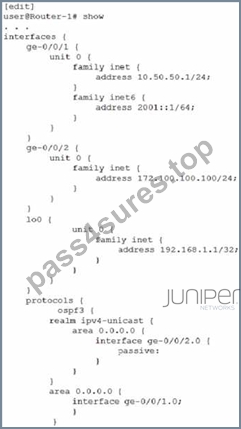
There is a functioning OSPFv3 neighborship between Router-1 and Router-2 over the ge-0/0/1 link. However, the 172.100.100.0/24 and 172.101.101.100/24 routes are not being shared through OSPFv3. Referring to the configuration shown in the exhibit, which two actions must you take to solve the problem? (Choose two.)
- A. Add interface ge-0/0/2 under OSPFv3 for both routers.
- B. Add the lo0 interface under OSPFv3 for both routers.
- C. Add the IPv6 family protocol under ge-0/0/2 for both routers.
- D. Add interface ge-0/0/1 under the IPv4 unicast realm for both routers.
Answer: C,D
NEW QUESTION # 81
Which two statements are correct about the deployment of EVPN-VXLAN on QFX Series devices? (Choose two.)
- A. Junos OS supports underlay replication for BUM traffic forwarding.
- B. Type 1 route advertisements always have the single-active flag set to 0.
- C. Junos OS supports ingress replication for BUM traffic forwarding.
- D. Type 1 route advertisements always have the single-active flag set to 1.
Answer: B,C
NEW QUESTION # 82
You are configuring a multi-area OSPF network. You have two areas and have configured one area as Area 1 and the other area as Area 2.
Which statement is true?
- A. The ABR will not create any type 3 LSAs between areas.
- B. Area 1 and Area 2 will not be able to route traffic to each other.
- C. Area 1 and Area 2 will be able to route traffic to each other.
- D. Both areas must be created as stub areas.
Answer: C
NEW QUESTION # 83
What is the role of IGMP in IP multicast?
- A. To provide end-to-end encryption for multicast streams
- B. To manage host group memberships on a local network
- C. To announce the availability of multicast sources to the network
- D. To synchronize multicast routing information across routers
Answer: B
NEW QUESTION # 84
Which two statements are true regarding packet loss priority in CoS? (Choose two.)
- A. A high loss priority guarantees forwarding.
- B. It is assigned to a packet on ingress.
- C. A low loss priority guarantees forwarding.
- D. It can be changed by a traffic policer.
Answer: B,D
NEW QUESTION # 85
You are deploying IP phones to a customer site. The IP phones will be installed to share a common access port with the user's desktop computer. You are required to provide a mechanism to place user data traffic and voice traffic in different VLANs for class-service application.
How would you implement this solution?
- A. Configure VLAN tagging on the IP phones and use the voice VLAN feature on the access ports to assign lagged frames to the voice VLAN and untagged frames to a data VLAN
- B. Configure the IP phones to label voice traffic with the DSCP of code point and apply a BA classifier to the access ports to classify voce traffic
- C. Configure flexible VLAN tagging on the user ports with the data and voice VLANs as members
- D. Apply a multifield classifier on the access ports that assigns voice packets to the assured forwarding class, based on the IP phone manufacturer's MAC QUI
Answer: A
NEW QUESTION # 86
Which two statements are correct about configuring OSPFv3 on a Junos OS router? (Choose two.)
- A. You must configure the IPsec transport mode to secure OSPFv3 communication.
- B. The subnet and subnet mask must match for an adjacency to form.
- C. You must configure the family inet6 parameter on the logical interface.
- D. The OSPFv3 router ID is inherited from the configured IPv4 address on the Io0 interface.
Answer: C,D
Explanation:
OSPFv3 uses a 32-bit router ID, which is typically inherited from an IPv4 address configured on the loopback interface unless manually specified.
OSPFv3 requires IPv6 to be enabled on participating interfaces, so the family inet6 parameter must be configured to allow the creation of IPv6 link-local addresses and neighbor adjacencies.
NEW QUESTION # 87
Which two statements are correct about EVPN/VXLAN deployments? (Choose two.)
- A. VNIs are used for encapsulating and de-encapsulating traffic entering and leaving the tunnels
- B. VTEPs are used to identify broadcast domains within an EVPN/VXLAN environment.
- C. VNIs are used to identify broadcast domains within an EVPN/VXLAN environment.
- D. VTEPs are used for encapsulating and de-encapsulating traffic entering and leaving the tunnels.
Answer: C,D
Explanation:
In an EVPN-VXLAN architecture, the interaction between the control plane (EVPN) and the data plane (VXLAN) is defined by specific functional components:
VTEP (VXLAN Tunnel End Point): These are the entities responsible for the encapsulation and de- encapsulation of Layer 2 Ethernet frames into Layer 3 UDP/IP packets. A VTEP can be a physical switch (like a QFX or EX series) or a software-based entity. When traffic enters the fabric, the ingress VTEP wraps it in a VXLAN header; the egress VTEP removes this header before delivering it to the destination host. (Option B) VNI (Virtual Network Identifier): The VNI is a 24-bit field in the VXLAN header that allows for up to 16 million unique identifiers. It is used to identify specific broadcast domains (or VLANs) within the overlay network. Each VNI effectively represents a virtualized Layer 2 segment that is stretched across the Layer 3 underlay. (Option D) Incorrect statements: Option A is incorrect because VNIs are identifiers, not the " engine " that performs encapsulation-that is the VTEP ' s job. Option C is incorrect because VTEPs identify the endpoints of a tunnel, not the individual broadcast domains themselves.
NEW QUESTION # 88
Referring to Spanning Tree Protocol, what is the function of Root Protection?
- A. It places a port into blocking state if a superior BPDU is received on that port.
- B. It identifies the true root bridge in a spanning tree domain.
- C. It sets a maximum BPDU threshold on the root bridge.
- D. It designates which ports are allowed to communicate with the root bridge.
Answer: A
NEW QUESTION # 89
......
Verified JN0-650 dumps Q&As - 100% Pass from Pass4sures: https://exams4sure.pass4sures.top/JNCIS-ENT/JN0-650-testking-braindumps.html